Even the less observant readers will have noticed that prominent red letter "A" decorating the sidebar beneath the picture of the devilishly handsome rogue who is sleeping with my wife.
It's okay, though. I'm sleeping with the devilishly handsome rogue's wife, too. And she's hot.
Anyway. The "A".
It's the symbol of Richard Dawkins'
OUT campaign, which seeks to encourage atheists to get loud and proud.
I first heard about it over at
Pharyngula, where the
usual argument ensued.
It is, indeed, true that getting atheists to do anything together is like herding cats. It stands to reason, if we were inclined to run with the crowd, we'd be religious.
Anyway, the usual problems with any symbol designed to represent atheism were raised.
First, that it's an "A". Whilst the word for atheist begins with an "A" in most languages, there are some in which it does not, and, of course, there are those languages which do not use the Latin alphabet, so "A" doesn't represent the word atheism everywhere.
Second, the "A" doesn't really represent atheism. It's just the first letter of the word, it doesn't really represent us or what we are.
Then there's the fact that it's a scarlet letter. Yeah, we get the whole "ironic twist" thing, but some aren't comfortable with it.
The atom symbol favoured by American Atheists is often rejected by non-Americans for that same reason, that it represents
American atheists.
Some propose using the "no" sign (red circle with a slash through it), usually over a crucifix or collection of religious symbols. Most reject this, as do I, because it makes a statement about what we are not, rather than what we
are.
Others favour the null set symbol "{}", but to me, that seems in need of too much explanation.
Still, mindful of the "put up or shut up" philosophy of life, I decided to see about designing an atheist symbol that addresses these issues.
I decided to work to the following requirements:
1) It must represent what atheism is, not what it is not.
2) It must either be understandable in any language, or translatable into any language without spoiling the integrity of the symbol.
3) It must be reasonably easy to understand with, if necessary, only the minimum amount of explanation.
Here's what I came up with:
One of the things I remember from school biology class is that there's this cool machine that makes squigly patterns when you connect it to peoples' heads.
Don't mind me, I'm just playing dumb.
It's called an
EEG, and there is a visible difference between the pattern generated by a
sleeping subject and that generated by an
awake subject.
There is also a marked difference between a person who is relaxed, and a person who is
thinking cognitively (which means thinking about stuff as opposed to thinking about an object they can see).
The latter are called
Gamma waves and, thanks to the nice people at the
Wikimedia commons, here is an example:

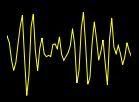
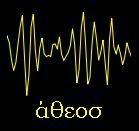
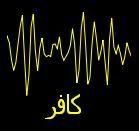
So, this is what it looks like when you think about stuff. What more perfect symbol could there be? This, in fact, is your brain on atheism. It's a little big, though. So I snipped an interesting looking bit out of the middle and, just because my blog has a black background, made it yellow-on-black:

Nice. It's like.. thought.. pictured..
Ahem.
Anyway, it's a little obscure, but no more so than a Crucifix or a Star of David would be if you didn't already know what they were.
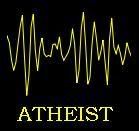
Okay, if you want, I'll add the word "Atheist" underneath:

Or, in French:

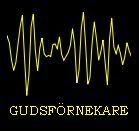
Swedish:

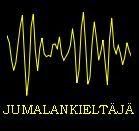
Finnish:

Greek:

Arabic:

Japanese:

You get the point. It's nice on its own, or you can put atheist in any language on there. You could put "freethinker" or "bright", if you favour those terms. You can put "my mind, my choice" if you're feeling subtly humourous, or "don't pray in my school and I won't think in your church" if you're feeling a little more in-your-face.
So, I extend the challenge:
Put up or shut up.
If you're an atheist and you don't like the symbols being used, come up with one of your own. See if you can convince anyone to use it.


 This sums it up, I think: